Lockheed Martin’s PAC-3 ACE warhead test has demonstrated the interceptor’s ability to stop a Class 3 drone, the company announced in mid-November 2026, completing the first development milestone for the lower-cost Patriot round. The PAC-3 Adapted Capability Effector (ACE) carries a blast-fragmentation warhead, and the company said the result moves the program toward a first flight in 2027.
The milestone matters because PAC-3 ACE abandons the hit-to-kill principle that defines the Patriot Advanced Capability-3 (PAC-3) family. Lockheed unveiled the missile at the Farnborough International Airshow on July 20, 2026, pricing it at less than half the unit cost of the PAC-3 Missile Segment Enhancement (MSE). That target responds to a structural problem exposed in Ukraine and the Middle East: Patriot batteries are expending multimillion-dollar interceptors faster than industry can replace them. The Army’s $9.8 billion multiyear award for 1,970 MSE rounds in September 2025, and a seven-year framework agreement signed in January 2026 to lift MSE output from about 600 to roughly 2,000 rounds per year, have not closed that gap.
PAC-3 ACE Warhead Test Validates Blast-Fragmentation Lethality
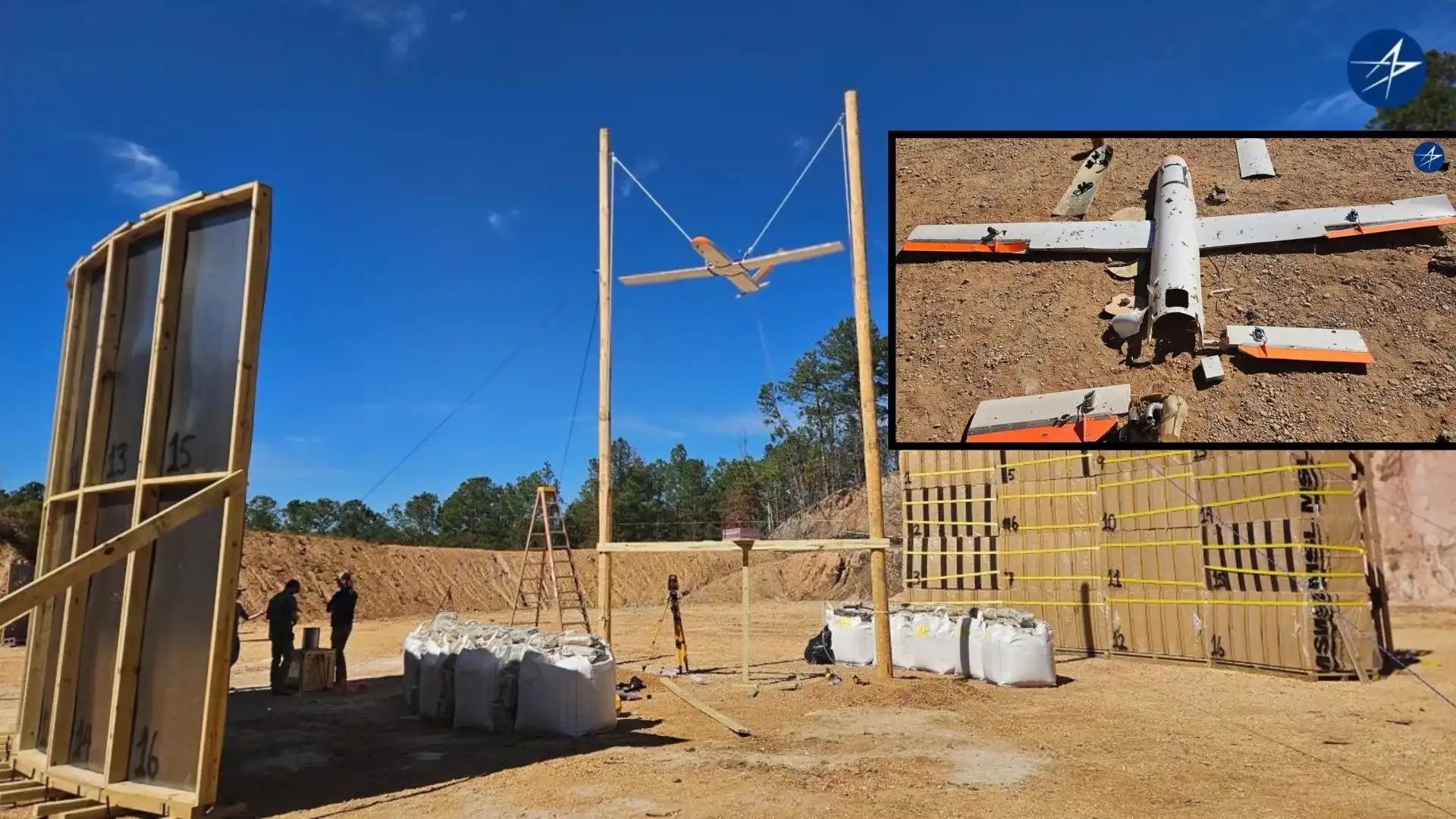
Lockheed disclosed few test parameters. The company said it gathered data on how the warhead performed and demonstrated its ability to stop a Class 3 drone. It did not release the test date, location or warhead mass. Company imagery shows a static arena setup, with the target suspended between towers and ringed by witness panels, then the airframe broken into several sections. This was a ground warhead characterization event, not a flight intercept.
The target class is operationally relevant. Lockheed’s “Class 3” designation appears to correspond to the Pentagon’s Group 3 category: unmanned aircraft weighing up to 1,320 pounds, operating below 18,000 feet and flying slower than 250 knots. That band includes the one-way attack drones Russia and Iran-aligned forces have launched in large salvos against air defense networks.
The warhead is the central design trade. Publicly available data indicate the PAC-3 MSE relies on direct body-to-body impact, backed by a small explosive Lethality Enhancer. ACE replaces that arrangement with a larger blast-fragmentation warhead, similar in concept to the PAC-2 Guidance Enhanced Missile-Tactical (GEM-T). A proximity kill relaxes end-game accuracy requirements, which in turn allows cheaper guidance and control hardware.
Single-Pulse Motor and Fin Controls Drive Down Interceptor Cost
Details Lockheed provided at AUSA 2026 indicate ACE swaps the MSE’s dual-pulse solid rocket motor for a single-pulse design and steers with aerodynamic fin controls instead of the attitude control motors used on hit-to-kill PAC-3 rounds. The missile retains an active radar seeker and integrates with Patriot fire control and Northrop Grumman’s Integrated Battle Command System (IBCS). Lockheed says ACE will use the launchers and command systems Patriot operators already field, sparing them new ground equipment.
The intended target set covers aircraft, cruise missiles, Group 3 drones, and close- and short-range ballistic missiles. The price of simplification is a shorter engagement envelope and less agility against maneuvering ballistic threats, which remain the MSE’s job. Open-source estimates place the MSE between $4 million and $5.3 million per round, putting ACE at roughly $2 million to $2.65 million. No exact price has been published.
Analysis: ACE is Lockheed’s bid to build a tiered Patriot magazine inside an architecture customers already own. Assigning a cheaper effector to drones and cruise missiles lets a battery reserve MSE rounds for ballistic threats, adding depth without new launchers or fire control. The drone test also exposes the limit of that logic. At an estimated $2 million or more, ACE still costs far more than the drones it would engage and more than double the $1 million ceiling the Army set for its Low-Cost Interceptor (LCI) effort. Its value lies in magazine depth, not cost parity.
The next milestone is first flight in 2027, consistent with the timeline Lockheed officials gave at the Association of the U.S. Army (AUSA) annual meeting in October 2026; July projections had pointed to early 2028. A company executive said ACE could be operational about 30 months after that briefing. Lockheed is not part of the initial LCI competition but may enter the next iteration the Army plans for 2027. No Army production contract for ACE has been announced, and warhead weight, range and production rate remain undisclosed.